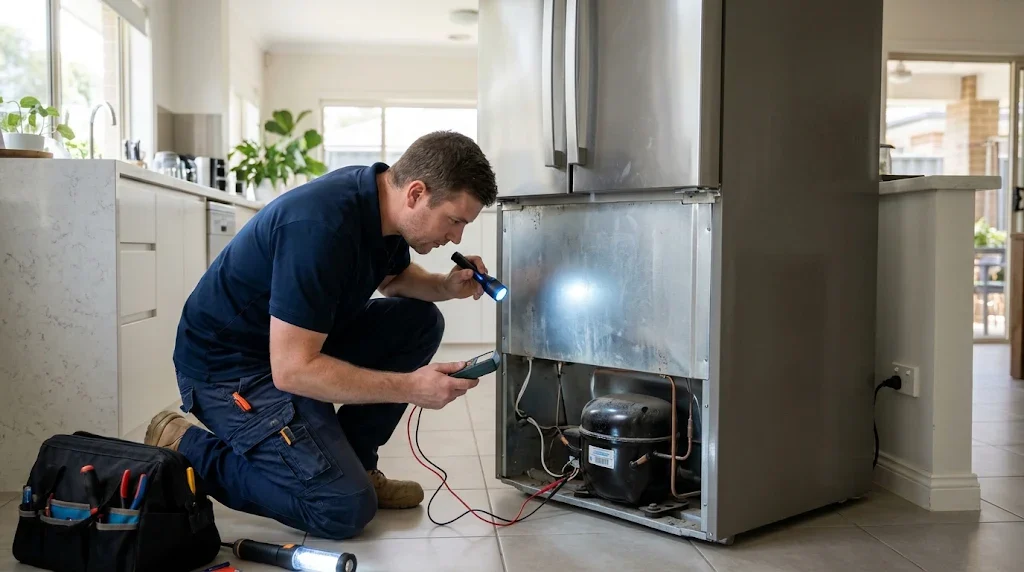
5 Warning Signs Your Fridge Compressor Is About to Fail
18 August 2026 · 5 min read
Why the compressor matters more than any other part
The compressor is the pump that keeps refrigerant moving through the sealed system. Every other component — the evaporator fan, the condenser coil, the thermostat — exists to support that one job. When the compressor is healthy, a fridge can run for well over a decade. When it fails, replacement is usually the only option, because compressors are sealed units that cannot be economically repaired on site.
That is exactly why catching a failing compressor early matters. Several faults look identical to compressor failure on the surface but are actually a failed relay, a blown start capacitor, or a stuck thermostat — all inexpensive, same day fixes. Confusing the two is the single most common way homeowners end up paying for a full replacement they never needed.
1. A loud buzzing or humming that keeps getting louder
Every compressor makes some background hum — that is normal. What is not normal is a hum that has become noticeably louder over the past few weeks, or one accompanied by a rattling vibration you can feel through the cabinet. This usually signals the compressor motor is under mechanical strain, often because refrigerant pressure has drifted out of range.
2. Repeated clicking every few minutes
This is the sound of the compressor trying to start and failing. Most of the time this is the compressor relay or start capacitor giving out, not the compressor itself, but the longer a failing relay is left in service the more strain it puts on the compressor windings. Left unaddressed for weeks, a cheap relay fault can eventually take the compressor down with it.
3. The fridge runs constantly and never seems to reach temperature
A compressor losing efficiency has to run longer to move the same amount of heat. If your fridge used to cycle on and off every twenty minutes and now runs almost continuously, and the condenser coil is clean and unobstructed, the compressor itself may be losing pumping capacity.
4. The compressor is hot to the touch and the fridge trips the breaker
A compressor with a shorted winding draws excess current, heats up rapidly, and can trip an overload protector or your home circuit breaker repeatedly. This is one of the few compressor symptoms that genuinely does point to the compressor itself rather than a supporting part, and it should be treated as an electrical fault — switch the fridge off at the wall and book a technician rather than resetting the breaker repeatedly.
5. Oil residue near the compressor base
A small amount of oily residue pooling near the compressor housing usually means the sealed system has a leak at the compressor itself, letting refrigerant and lubricating oil escape together. This is a job for a licensed technician with refrigerant handling accreditation, and it is worth an honest conversation about repair versus replacement depending on the fridge's age.
The bottom line
If you are hearing any of these symptoms, do not assume the worst before a proper diagnosis. A same day technician can test start current, winding resistance and relay operation on site in minutes, and in a large share of cases the fix is a $50–150 part rather than a full replacement.
Need a Fridge Repaired Today?
Our technicians cover every area of Sydney and are online around the clock. Send your suburb, fridge brand and fault, and we will confirm your same day arrival window.
Most fridges are built to last 10–15 years, but Sydney conditions — heat, humidity, coastal salt air — can shorten that. Here is what actually determines how long yours will hold up.
Not every warm fridge needs a technician. These seven checks take fifteen minutes and can save you a callout — or tell us exactly what to bring when we do come out.
A slow leak under the crisper drawers looks harmless. Left long enough, it can reach timber flooring and cause damage that costs far more than the original repair.